Glass Cleaning
Industrial Cover Glass Cleaning for Better Surface Quality and Process Stability.
Glass cleaning is a critical process throughout cover glass manufacturing. It helps remove particles, oil, grinding debris, and surface residues before key stages such as printing, coating, bonding, inspection, and packaging.
What Is Glass Cleaning in Cover Glass Manufacturing?
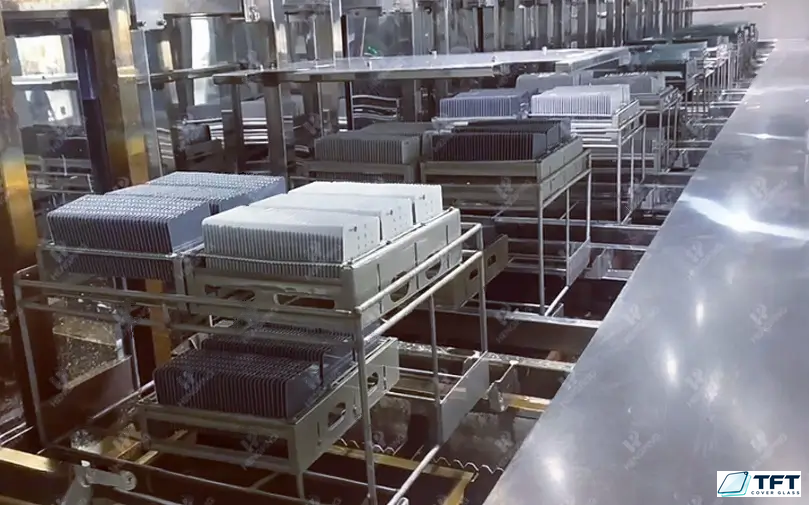
Glass cleaning in cover glass manufacturing refers to the controlled removal of dust, particles, oil, polishing residue, and other surface contaminants during different stages of fabrication. It is used to prepare the glass surface for important downstream processes such as silk-screen printing, AG/AR/AF coating, lamination, inspection, and packaging.
Unlike general cleaning, industrial glass cleaning is closely related to process control, product quality, and production efficiency. For cover glass used in industrial displays, medical devices, smart home panels, and electronic equipment, surface cleanliness directly affects final performance and appearance.
Why Cleaning Matters Throughout the Cover Glass Fabrication Process?
Cleaning is a critical process throughout cover glass manufacturing, as it is required at multiple stages such as cutting, CNC processing, polishing, tempering, silk-screen printing, surface coating, OCA lamination/tape bonding, quality inspection, and packaging. During these processes, contaminants like glass particles, dust, oil, fingerprints, powder, and chemical residue can remain on the surface and interfere with downstream production.
Proper cleaning helps prepare the glass for the next manufacturing step, improves surface condition, supports better adhesion and coating performance, reduces defect risks, and helps maintain stable production. That is why cleaning is a key part of quality control in custom cover glass fabrication.
Cleaning Objectives at Different Manufacturing Stages
| Process Stage | Main Cleaning Purpose | Quality Focus |
|---|---|---|
| After CNC Machining | Remove glass particles, abrasive residue, and oil contamination left by CNC processing | Helps prevent scratch damage on the glass surface |
| After Edge Polishing | Remove polishing powder and fine surface residue | Helps reduce the risk of tempering defects, reaction marks, dents, and other cosmetic issues |
| After Tempering | Remove residual compounds remaining on the glass surface after tempering | Helps keep the surface clean for subsequent processing |
| Before Silk-Screen Printing | Remove oil, dust, and surface residue | Helps improve ink appearance and adhesion |
| After Silk-Screen Printing | Remove powder, residue, and post-process contamination | Helps prepare the glass for the next manufacturing step |
| Before Coating | Remove oil, dust, and surface contaminants | Helps improve coating consistency and adhesion |
| After Coating | Remove oil stains, powder, and remaining residue | Helps reduce appearance defects such as contamination marks and white spots |
Common Contaminants Found on Cover Glass Surfaces
During fabrication, different types of contaminants may remain on the glass surface, including:
Cutting Oil and Fluid Residue
Grinding Dust and Edge Debris
Polishing Powder and Residue
Fingerprints and Handling Marks
Fine Particles from Transfer
Water Marks and Wash Residue
These contaminants may seem minor, but they can create visible defects, reduce coating consistency, affect print adhesion, or lower the overall surface quality of the glass panel.
Cover Glass Cleaning Technologies
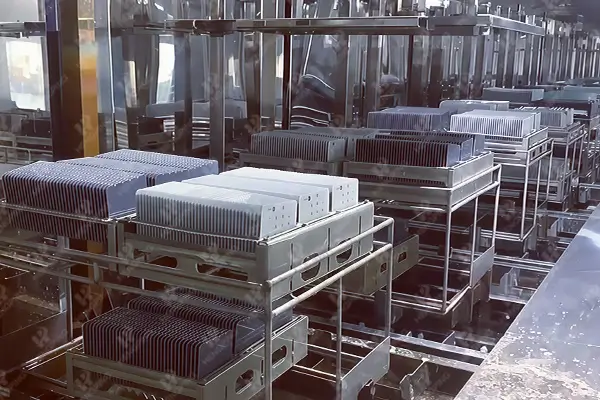
Different cover glass products require different cleaning methods depending on size, surface condition, and downstream process requirements. In practical production, ultrasonic cleaning and flat brush cleaning serve different roles and may also be combined for better efficiency and stability.
Ultrasonic Cleaning Vs. Flat Brush Cleaning
Ultrasonic Cleaning Method
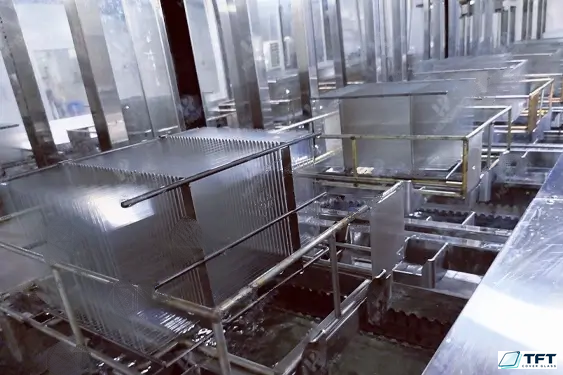
Ultrasonic cleaning is based on the cavitation effect. Under high-frequency ultrasonic vibration, typically at 28 kHz or 40 kHz, bubbles are generated in the cleaning liquid. As these bubbles expand and collapse, they create localized pressure and micro-jets that help remove contamination from the glass surface.
This method is effective for removing polishing powder, oil contamination, adhesive residue, fine particles, and fingerprints, especially in areas such as edges, holes, gaps, and other difficult-to-clean zones. When combined with alkaline solution and surfactants, loosened contamination can be carried away and filtered out of the system.
Ultrasonic cleaning is generally more suitable for:
Small-Size Products
Polished Glass Products
Thin Cover Glass Below 2 mm
Higher Surface Cleanliness Requirements
To avoid cleaning-related scratches, the ultrasonic tank should be checked daily for broken glass or other foreign matter. During water replacement, the tank walls should also be cleaned thoroughly.
Flat Brush Cleaning
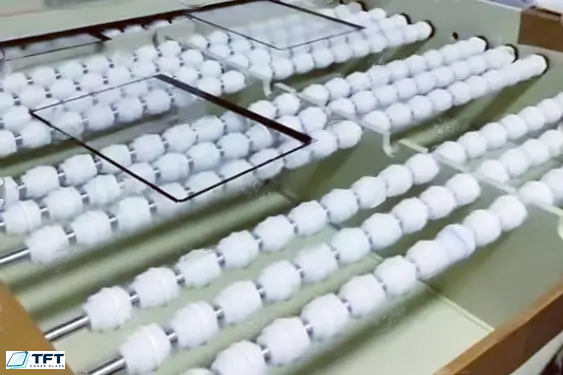
Flat brush cleaning uses mechanical brushing combined with continuous spray rinsing. During operation, the glass moves through the machine while upper and lower soft brushes clean the surface, helping remove larger particles and heavier surface contamination.
This method is effective for removing large dust particles, coarse polishing powder, thick oil film, and floating debris from the glass surface. Spray rinsing with cleaning solution or pure water helps wash away loosened contamination and reduce the risk of reattachment during the cleaning process. It is often used as a practical pre-cleaning step before finer cleaning stages.
Flat brush cleaning is generally more suitable for:
Large-Size Products
Non-Polished Glass Products
Higher-Output Production
Efficient Line Processing
A typical flat brush cleaning process may include alkaline brush washing, pure water brush rinsing, and air knife water removal with pre-drying, helping prepare the glass for the next production step.
In practical production, the most effective solution is often to use flat brush cleaning first for coarse cleaning, followed by ultrasonic cleaning for fine cleaning. This combination helps improve cleaning efficiency, reduce contamination load in the ultrasonic tank, extend filter life, and support more stable production yield.
In general, small-size or polished glass products are more suitable for ultrasonic cleaning, while large-size or non-polished products are often better suited to flat brush cleaning.
How We Choose the Right Cleaning Method for Each Project?
At TFT Cover Glass, the cleaning process is selected based on the actual needs of the custom glass project. Our team considers factors such as:
Glass Thickness
Affects cleaning method selection, handling stability, surface protection, and process control requirements.
Panel Size and Shape
Larger sizes or complex shapes may require more suitable cleaning flow and handling control during production.
Surface Quality Requirement
Higher surface standards require better cleaning control to reduce particles, residue, and cosmetic defects.
Downstream Printing or Coating
Cleanliness must match the needs of printing or coating to support adhesion, consistency, and appearance.
Production Volume
Cleaning methods should fit the required output, balancing surface quality, efficiency, and line stability.
Final Application Environment
End-use conditions influence cleanliness expectations, appearance standards, and process selection.
At TFT Cover Glass, cleaning method selection is based on product structure, contamination type, downstream process sensitivity, and production efficiency targets.
Cleaning inspection before packing
Identify the optical viewing area and the surfaces that will be bonded. Specify the residue or particle limits for those areas before the packing method is agreed.
See inspection methodsCustom Glass Fabrication Expert
TFT Cover Glass, a custom glass fabrication expert, delivers precision-machined glass products with unmatched quality and competitive pricing. Utilizing custom-designed CNC machinery and a vast inventory of materials, we expertly handle projects from prototypes to large-scale production, supporting customers from prototyping through production.
- UV Printing
- Surface Coating
- Adhesive Bonding
- Ultra Cleaning
- Testing and Inspection
- Packaging
- AGC Dragontrail™ Glass
- NSG Glass
- AG Glass
- Panda Glass
- Sada Lime Glass
- Borosillicate Glass
- SCHOTT Glass
- Ultra-clear Glass (Low-iron Glass)
- 3D Curved (Hot Bending) Glass
- Electronics
- Smart Home
- Automotive
- Industrial
- Home Appliances
- New Energy
- Medical
- Wearable Devices
- Lighting
- Commercial
- Outdoor
- Optical
Request A Free Quote
We treat your inquiry and drawings as confidential.
Contact
We’d love to hear about your project. Reach out for questions, technical support, quotes, or free samples. Upload your drawings if available for more accurate recommendations. Our engineers will give you a reply within 24 hours and provide professional recommendations tailored to your exact requirements.
- +86 131 1396 8188
- +86 131 1396 8188
- kevin.zhichuansz@gmail.com
- Lifeng Industrial Park, Longgang District, Shenzhen 518115, Guangdong, China
 EN
 FR
 DE
 ES
 PT
 IT
 NL
 DA
 RU
 AR
 TR
 JA
 KO
 ID
 UK
 TH
 VI
 PL
 MS
 ET
 EL