Introduction
In the production of high-quality cover glass, particularly for touch-interactive interfaces and optical electronic devices, surface properties are just as important as the glass’s structural integrity. You may often hear about “Hydrophobicity” or “Anti-finger (AF) Coatings,” but how do manufacturers quantitatively measure these invisible properties? The answer lies in the Water Contact Angle (WCA) Test.
As a professional cover glass manufacturer, TFT Cover Glass strictly controls every surface treatment process. This article provides a detailed guide to water contact angle testing, its principles, methods, and industry standards, to help you understand why this metric is a critical indicator of cover glass quality.
What is Water Contact Angle? Hydrophilic vs Hydrophobic Surfaces
The Water Contact Angle (often referred to as Water Drop Angle) is a quantitative measure of the wettability of a solid surface.
The Scientific Principle
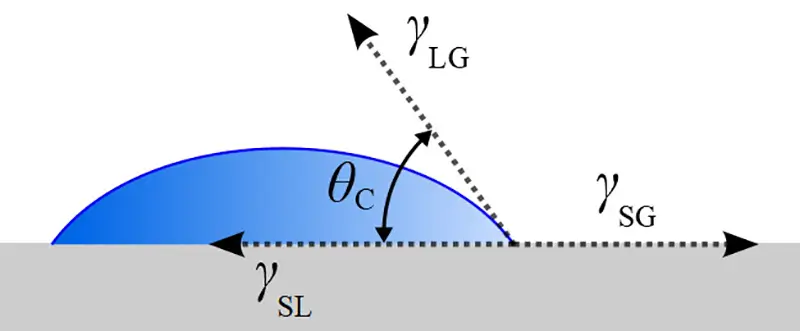
When a liquid droplet rests on a solid surface, it forms a specific shape due to the interplay of three interfacial tensions: solid-liquid, gas-liquid, and solid-gas. This relationship is described by Young’s Equation.
The Definition
It is the angle (θ) formed between the tangent of the liquid-gas interface and the solid-liquid interface at the three-phase intersection point.
How to Interpret the Angle?
The rule of thumb is straightforward: The higher the Water Contact Angle (WCA), the better the hydrophobicity; and better hydrophobicity means superior Anti-Fingerprint (AF) performance.
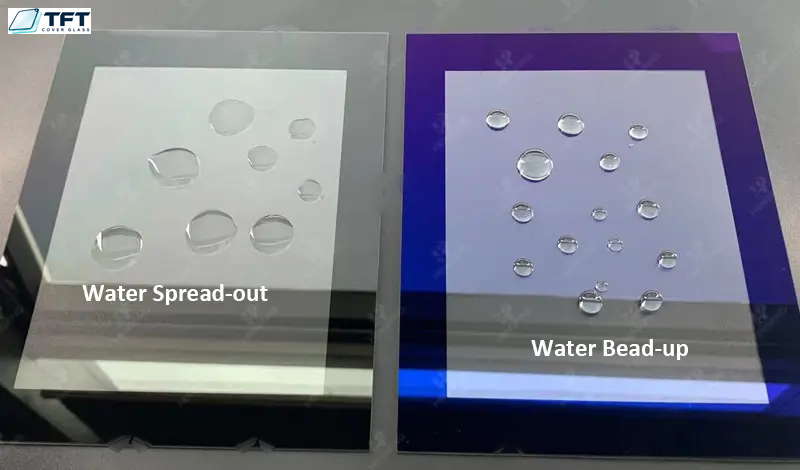
θ< 90° (Hydrophilic):
The surface has high wettability (high surface energy), causing water to spread out. This typically indicates a raw, untreated glass surface that is chemically clean.θ> 90° (Hydrophobic):
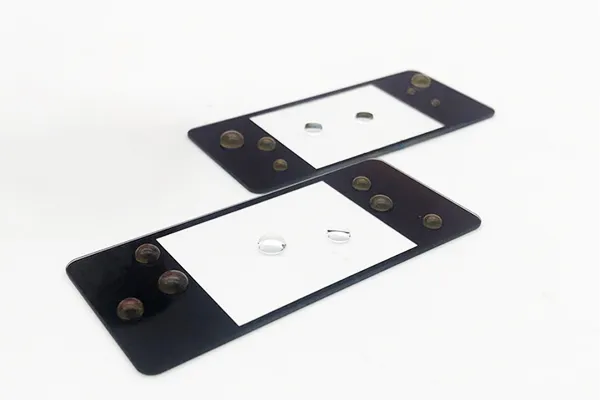
The surface has low wettability (low surface energy), causing water to bead up. This confirms the presence of an anti-fingerprint (AF) coating.θ≥ 100°~105° (Standard Grade):
This range is common for general glass panels and indicates a basic level of anti-fingerprint performance.θ≥ 110° (Premium Grade):
This is the target for high-requirement cover glass panels. Generally, this standard can be achieved using the AF spraying process with proper equipment, signifying excellent smudge resistance and a superior, silky-smooth touch experience.
Why Do We Perform WCA Testing on Cover Glass?
WCA testing is used throughout the manufacturing lifecycle to ensure three key factors: Cleanliness, Uniformity, and Performance.
1. Assessing Surface Cleanliness (Pre-Coating)
Regardless of whether AF coating will be applied, the bare glass substrate must be perfectly clean before any processing.
- The Logic: Clean glass has high surface energy. If water is dropped on it, the contact angle should be low (the droplet spreads).
- The Detection: If the contact angle is unexpectedly high, it indicates the presence of organic contaminants (like oil or grease) preventing the water from spreading. This “Water Film Residue” principle helps us identify cleanliness issues that the naked eye cannot see, preventing coating failures later on.
2. Verifying Coating Performance (Post-Coating)
For projects that require anti-fingerprint (AF) treatment, WCA testing is the primary method to verify success.
- The Logic: A successful anti-fingerprint (AF) coating reduces surface tension.
- The QC Standard: We look for a high contact angle. For high-quality cover glass, the standard requirement is typically ≥95°. If the angle is lower, the coating may be too thin or defective.
3. Evaluating Uniformity and Durability
- Uniformity: By testing multiple points (e.g., 5 points) across the glass surface, we can ensure the coating is applied evenly.
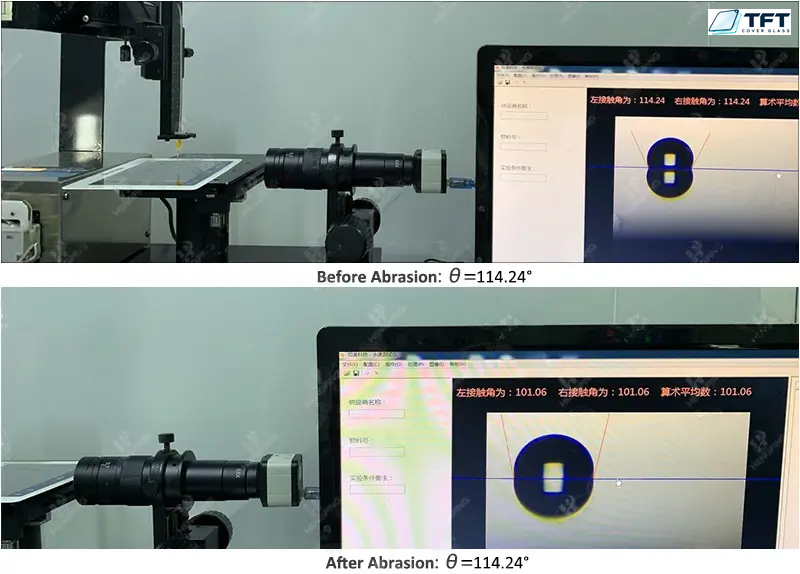
- Durability: We perform WCA testing after abrasion tests to ensure the coating withstands real-world use.
The Three Key Testing Stages in Production
At TFT Cover Glass, strictly controlling every pass guarantees the highest quality. We implement WCA testing at three distinct stages:
- Pre-Treatment Stage (Cleanliness Check):
To verify the glass is chemically clean and ready for bonding. A low contact angle here ensures no organic contaminants are present. - Finished Product Stage (Performance Check):
Direct testing on the coated glass to verify the initial hydrophobic performance. We verify uniformity by testing multiple points (e.g., 5 points) across the surface. - Reliability Testing Stage (Durability Check):
We perform WCA testing after friction/wear cycles to analyze the lifespan and adhesion of the coating.
TFT Cover Glass recorded the following water contact angles on one anti-fingerprint coated glass sample before and after abrasion.
- Initial WCA: >105°
- Abrasion Test: 500g load, 0000# steel wool, 2,000 cycles (back-and-forth).
- Pass Criteria: The contact angle decay must be within 15% post-test.
How is the Test Performed? (The Process)
The testing involves a sophisticated instrument known as a Contact Angle Meter (or Goniometer).
The “Sessile Drop” Method:
- Leveling: The sample glass is placed on a leveled stage.
- Droplet Formation: A micro-syringe dispenses a precise amount of liquid (usually deionized water) to form a droplet on the needle tip.
- Transfer: The stage is raised until the glass touches the droplet, then lowered, leaving the droplet sitting on the glass surface.
- Capture & Calculation: A high-speed camera captures the image of the droplet. Software analyzes the curve (using methods like the
θ/2θ/2method or Ellipse fitting) to calculate the exact angle.
Advanced Note: For complex surface energy analysis, the Owens-Wendt Method can be used. This involves testing with two different liquids (one polar, one non-polar) to calculate the solid’s dispersive and polar surface energy components.
Industry Applications & Standards
Industry Applications & Standards
Water Contact Angle testing is not limited to a single field; it is a universal benchmark for quality across various high-precision sectors.
Common Applications
WCA testing is standard practice across industries requiring precision surfaces, including:
- Consumer Electronics: Smartphone cover glass, tablet screens, and notebook housing.
- Optics: Camera lenses (CMOS), sapphire glass, and UV/IR filters.
- Displays: LCD/LCM panels.
- Semiconductors: Si wafers and circuit boards.
Relevant Standards
To ensure consistency and reliability, we adhere to recognized international testing standards such as:
- ASTM D5946: Standard Test Method for Corona-Treated Polymer Films using Water Contact Angle Measurements.
- GB/T 24368: Detection of hydrophobic pollutants on glass surfaces.
Conclusion
Water contact angle (WCA) testing is the “stethoscope” of cover glass manufacturing. It allows us to diagnose invisible surface properties, ensuring that the glass meets the precise standards required for its specific application.
Whether verifying the durability of a premium touchscreen coating or simply confirming the absolute cleanliness of a substrate, this test provides the data needed to guarantee quality. By leveraging these insights, TFT Cover Glass minimizes rework and delivers cover glass solutions that are perfectly aligned with your project’s unique requirements.


 EN
 FR
 DE
 ES
 PT
 IT
 NL
 DA
 RU
 AR
 TR
 JA
 KO
 ID
 UK
 TH
 VI
 PL
 MS
 ET
 EL